
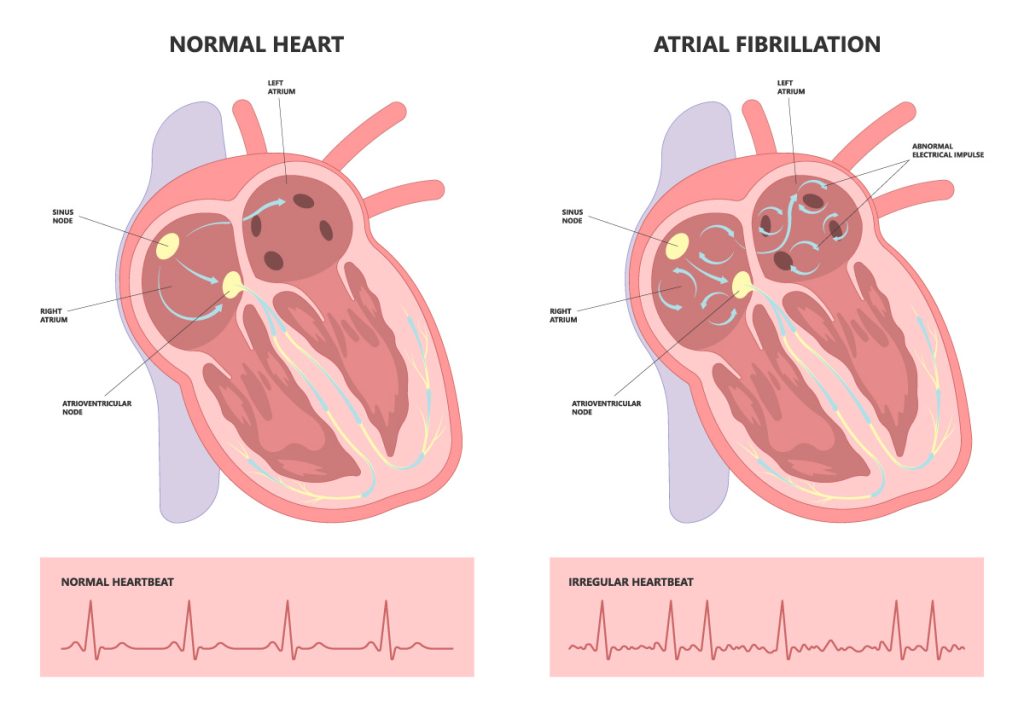
 Our heart is a complex and miraculous organ. Imagine a mini electrical system right in your own body that controls the beats that keep us alive and thriving. Your heart’s unique electrical system regulates its ability to pump blood. However, sometimes that system can get thrown off. Atrial fibrillation (known as AFib) is another term for a heart arrhythmia, an irregular and often rapid heart rhythm. While AFib isn’t usually life-threatening on its own, it causes your heart to work harder than usual and not operate efficiently. While AFib often has telltale signs, patients don’t always show symptoms. Heart health and early detection are two reasons why it’s so important for adults to see their primary care doctor regularly.
How Does AFib Work?
Your heart has four chambers: the left and right atrium (plural atria) on top and the left and right ventricle below. The atria help control your heartbeat while the ventricles pump blood to your body. Sometimes, the atria beat irregularly and get out of sync with the ventricles, slowing or disrupting your blood flow. Heart arrhythmias can be related to your heart’s sinus node, a small group of cells in your right atrium. The sinus node, often referred to as your heart’s natural pacemaker, sends out those vital electrical pulses that create the pattern of your heartbeat.
An adult’s resting heart rate is usually 60 to 100 beats per minute. In AFib, we often see 100 to 175 beats per minute.
How Do I Know If I Have AFib?
AFIb can be occasional or persistent/chronic. Symptoms include heart palpitations (feeling like your heartbeat is fast, fluttering or pounding), chest pain, dizziness, fatigue, lightheadedness, weakness or shortness of breath. However, sometimes people with AFib don’t experience obvious symptoms. It’s one reason your primary care doctor checks your heart health at your annual physical.
What Causes Atrial Fibrillation?
Causes of AFib can include the following:
- Congenital heart defects: a problem with the structure of your heart that you’re born with.
- Sleep apnea: a sleep disorder where your breathing stops and starts repeatedly
- High blood pressure: a chronic condition that occurs when the pressure of blood flow on the arteries is too hard.
- Heart valve disease: when the heart valves that open and close to help blood flow to different parts of your heart become stiff, loose or fail to open and close properly.
- Coronary artery disease occurs when fat and cholesterol build up in the arteries, limiting blood flow to the heart.
- Heart attack: when a fatty deposit in the artery ruptures and causes a blood clot, blocking blood flow to the heart and causing damage to the muscle.
- Sick sinus syndrome: a dysfunction of the sinus node that causes slow or irregular heartbeats.
- Viral infections can cause inflammation and trigger an immune response in your heart, impacting its ability to regulate electrical pulses.

Is AFib Dangerous?
Usually, AFib itself isn’t life-threatening. However, it can cause or indicate serious conditions, so detection and diagnosis are vital. Stroke and heart failure are two of the most significant conditions tied to AFib. A stroke occurs when a blood vessel carrying blood to your brain is blocked. According to the American Heart Association, patients with AFib are five times more likely to have a stroke as circulation problems related to AFib increase the likelihood of blood clots in those essential blood vessels.
AFib is also tied to heart failure, which occurs when your heart doesn’t pump blood effectively.
Do I Need A Pacemaker?
If your heartbeat is slow, it may not get the oxygen it needs. For many patients, a pacemaker is the solution. A pacemaker is a tiny computer surgically implanted to speed up and regulate your heart’s rhythm. If you’re diagnosed with Atrial Fibrillation, your primary care doctor will refer you to a cardiologist, and you can discuss options for treatment based on your unique needs.
When Should I See My Doctor?
If you have chest pains, go to the emergency room. Your primary care doctor is an excellent place to start for other symptoms. “AFib is one of those quiet conditions that may not be immediately obvious,” says Dr. Mamta Ojha of Norvinia Health. “Some patients don’t experience any of the red flag symptoms. It’s one reason routine care and checkups are so important for adults.” Your primary care doctor is an excellent first resource regarding heart health. If you have cardiac concerns or are overdue for a checkup, Norvinia Health can help.